A Failed Experiment in Shelton
Trying to sustain forests and jobs on the Olympic Peninsula
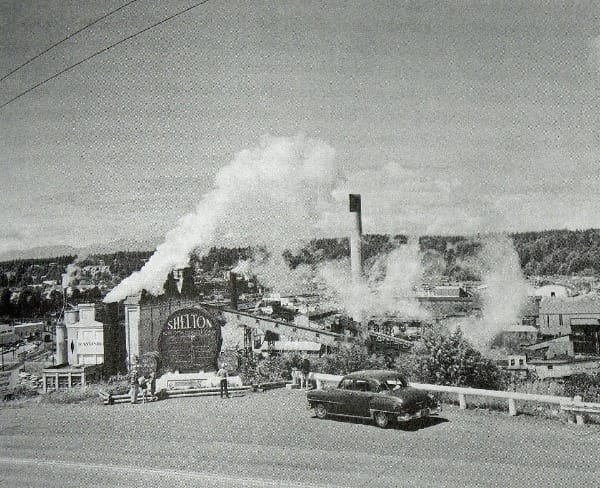
Washington’s timber industry struggled in the 1930s. The reasons were not mysterious.
In the 1920s, loggers cut trees faster than ever. For five straight years, the industry in Washington processed more than seven billion board feet—enough to build more than 400,000 homes each year. For the rest of the century, the state’s timber industry topped that quantity only four times.
Lots of logging meant lots of forest products and that drove market competition up and pushed prices down. Timber companies simultaneously saw profits drop and their property become hills of stumps. The future looked bleak.
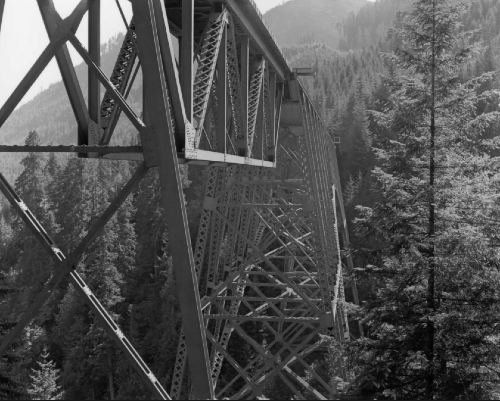
Congress and the U.S. Forest Service devised an innovative solution, known as the Sustained-Yield Management Act (1944). Two days after President Franklin Roosevelt signed the law, the Simpson Logging Company signaled its interest. Under the law’s authority, a signed contract went into effect in 1947 to guide the Shelton Cooperative Sustained-Yield Unit across some 270,000 acres, which grew over time.
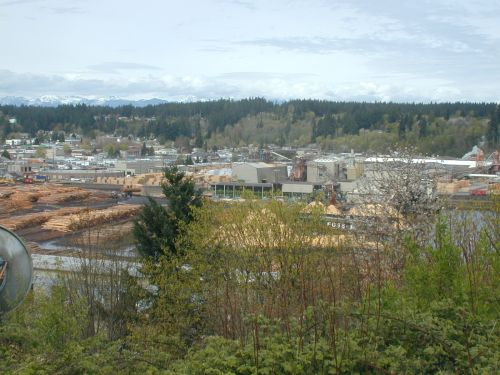
The Simpson Logging Company was based in Shelton, Washington, on the eastern edge of the Olympic Peninsula, and it employed more than 6,000 workers in the woods and mills. In its home county, Mason, forests covered 95% of the land, split between Douglas fir and hemlock. About half the land was privately held; the other half contained in Olympic National Forest. But of the available merchantable timber, only 11% was on private land.
In other words, almost all the private forests had been cut—and that’s why Simpson was feeling desperate.
The company’s experts estimated it controlled enough timber to last its mills about eight more years. Without access to federal timber—a lot of federal timber—the company and the mill towns were doomed.
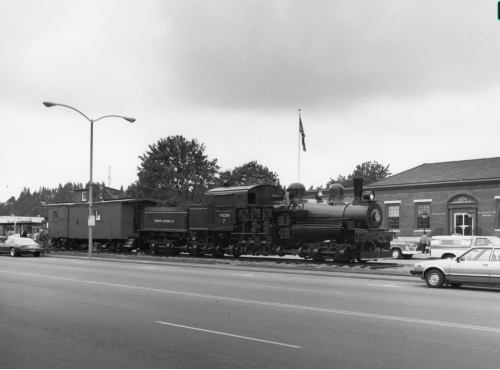
The Sustained-Yield Management Act tried to solve several problems that the Depression had revealed so starkly.
First, it limited competition, which helped in two ways. One, it guaranteed a company access to all the available timber in a designated unit; it would not have to bid to gain control in repeated timber sales. Two, by having that guaranteed access, companies would theoretically slow the cutting in the woods which in turn would slow the market saturation of wood products and help to raise prices.
Second, the act instituted a long-term plan, 100 years in the case of Simpson. This would allow companies to slow their cutting theoretically to no greater than the regeneration rate. At the end of the century, the forest being cut would be effectively no worse for wear. Forest cut would be replaced by forest regrown.
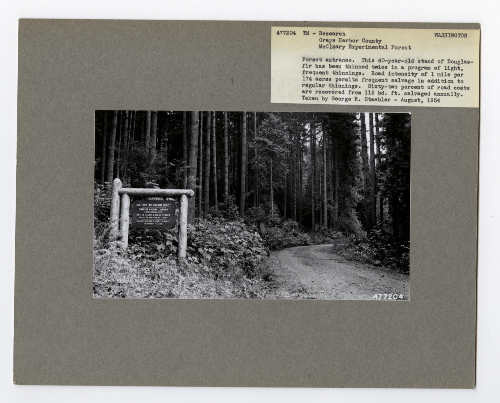
Third, for cooperative agreements, the law allowed a unit of public-private timber to be managed as a whole. For Simpson, this would allow the company to manage its woods and the national forest on a sustained-yield basis together, which effectively allowed a company to cut public trees while its private forestlands grew back. (The law also allowed for contracts that were not cooperative, which just meant a company in such an agreement would have access only to national forest units.)
Fourth, the legislation would provide a steady supply of logs to mills, ensuring not only an assured company profit but also regular employment for laborers. The threat of closing mills for lack of logs loomed over every policy discussion in the postwar era.
In short, the law provided favored terms to a company to enforce a long-term, sustainable timber program good for local communities and forests.
This was the theoretical case.
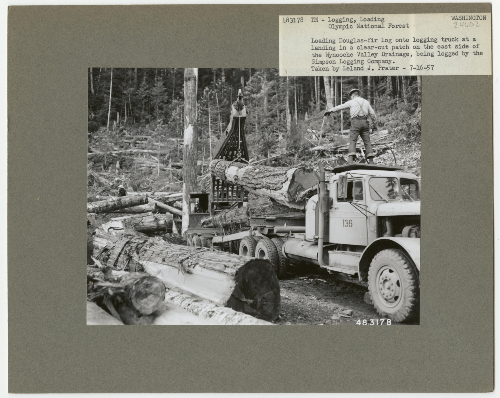
National forests had been created partly to provide against a timber famine that 19th-century conservationists feared. A famine of sorts had come to the Northwest when private companies like Simpson and Weyerhaeuser mowed through hundreds of thousands of acres and needed other sources. If companies’ holdings were large enough, like Weyerhaeuser, they could afford to wait.
But the pressure to open up national forest for industrial logging became too great to resist. All those towns needed logs to run through mills to keep people employed. Still, the Forest Service always had Gifford Pinchot’s mantra in the back of its mind: the greatest good for the greatest number for the longest time. The agency promised to manage its forests for long-term, which could only happen if some sort of sustainability standard were adopted.
Yet, a quiet revolution in the 1920s and 1930s shifted forestry’s thinking about sustained yields. The term stopped being focused on forest production and was redirected toward mill production. What was being sustained in these theoretical discussions and this legislation was mill jobs, not forest growth.
And with that as the driving criteria and the specter of masses of unemployed loggers and mill workers, the Forest Service allowed greater and greater ransacking of public timber in the short term. By not being rigorous, the agency cooperated with the industry to shift the day of reckoning but not to end its threat.
The Forest Service assumed this program would be popular. It wasn’t. Shelton’s was the only cooperative agreement that ever went into effect. Five other sustained-yield units went into operation but without the mixed private-public timberland. The law quietly died out. But the slippery use of “sustained yield” did not—a topic for another day.
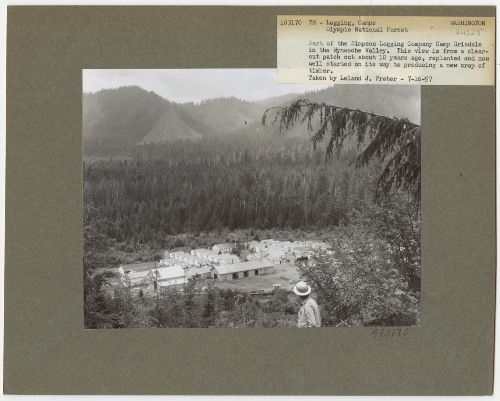
Despite more or less failing, this experiment in one corner of Washington’s timber economy reveals a volatile mix of public lands, industrial capitalism, and long-term management of both.
A willingness to experiment is laudable. When Murray Morgan wrote about it in The Last Wilderness: A History of the Olympic Peninsula, not even a decade into it, he expressed optimism:
When the agreement expires, on New Year’s Eve in the year 2046, our grandchildren will have standing on these acres as much timber as we do now. It is a cheering thought.
The cheerful optimism was misplaced. In 2002, the company and the Forest Service mutually agreed to end the agreement. Environmentalists faulted the agreement for allowing too much logging, which harmed habitat. At the time of its demise, Simpson only employed 1,400 people, so the economic planning seemed to miss the mark as well.
The scale of economic growth and ecological functioning seem at odds. This attempt to mesh them failed. But the problems the Sustained-Yield Management Act attempted to solve remain in some form or another. Unfortunately, long-term thinking remains a consistent challenge for policymakers and industry leaders.
Comments ()