A Lover and Nurturer of Words
Rick Ardinger's life of service to the humanities
Introduction
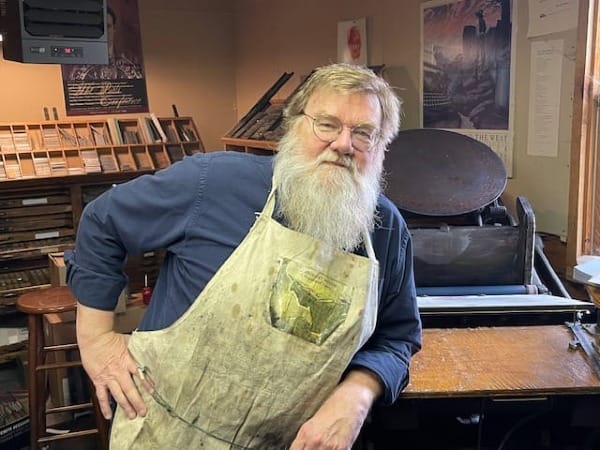
Spending almost 20 years at the University of Idaho, I had multiple occasions to have my career affected positively by Rick Ardinger. During all but the last handful of those years, Rick served as the Idaho Humanities Council's executive director. His position and longevity in the role—he worked at IHC for 27 years—meant he was arguably the most influential force for the humanities in the state at the turn of the 21st century. Teacher institutes and research grants and public programming of various kinds, including one to celebrate the 50th anniversary of the Wilderness Act that I participated in, elevated the discussion of literature, history, and the arts in Idaho.
In retirement, his and mine, Rick has continued to be a nurturer. In the 1970s, Rick and his wife Rosemary started a literary magazine and press. While the press continued throughout his career, the literary magazine fell by the wayside. But The Limberlost Review has been revived in his retirement. One feature of the journal is a Re-Readings section where writers spend time with a favorite text. On Rick's invitation, I shared one essay, and another one is forthcoming next year. His love of words and advocacy for a type of education that encompasses humanities and the arts is refreshing—and needed. Rick's life has been a model of service to the humanities.
A Lover of Words
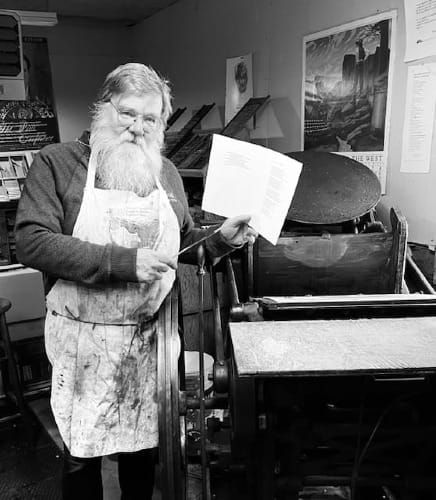
Rick Ardinger lives in the mountains north of Boise, a far distance from his childhood in the steel town landscape of western Pennsylvania. Those distant roots, however, continue to shape his championing of literature and history across the American West. The humanities, after all, provide the essential foundation for a responsible civic life, something he tasted early and has refined ever since.
His life centered on words began in childhood, nurtured by his mother.
My mother was always good at reading to us. She used to recite nursery rhymes until we knew them by heart by the time we were toddlers.
It had a good effect not only on Rick but one of his older brothers who became an English professor.
Building on this strong foundation at home, a high school teacher named Calvin Morgan, who "really threw out the textbook," inspired Rick.
He would each day bring in poems. So we got to know the history of American poetry from Walt Whitman all through up to Bob Dylan. He talked to us like we were college students and taught us everything about contemporary poetry and Walt Whitman and Carl Sandburg and T.S. Eliot and Robert Frost. We had to learn to recite some of this and keep it in our head. While class might be within a writing assignment, each one of us would have to come up and whisper these poems in his ear, and then he would give us a grade. He demanded that we learn some of these poems. It stuck with me my entire life.
Poetry became his enduring love of literature.
Rick headed out of the steel town of his youth to attend Slippery Rock University, in a "dry town way out in the middle of pastures."
There was nothing to do. We didn't have phones or anything like that. We didn't have television. Nobody had a car. So for entertainment you had to read your textbooks and a lot of books instead of our textbooks. Kurt Vonnegut, Soul on Ice, Our Bodies, Ourselves.
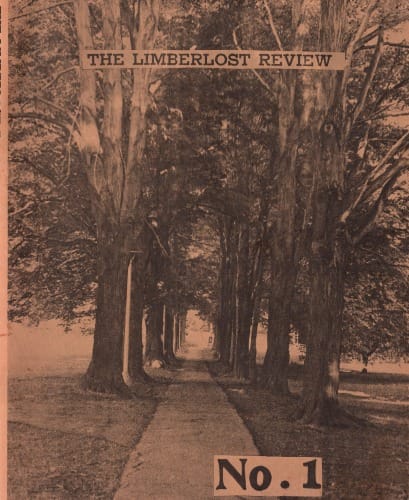
Meanwhile, Rick studied and wrote poetry. And when he graduated, he and his wife Rosemary moved to Massachusetts, where she was from and had obtained a job. And like many good literary-loving young people in the 1970s, they started a literary magazine, The Limberlost Review.
Developing The Limberlost Review and Limberlost Press
Small literary magazines were enjoying a heyday then. Rick attended a small press book fair at Harvard in the fall of 1975. He went table to table seeing wonderful magazines and thought, "I have got to get involved in this!"
I was a poet and I loved literature. It was a way of continuing on. It's like a responsibility. If I don't do it, who's going to do it?
Publishing The Limberlost Review in the 1970s demanded intensive work in those days before easy word processing. Rick remembers a lot of retyping. In short order, they had produced three issues.
Then serendipity intervened in two ways.
First, the Ardingers relocated to Pocatello so Rick could pursue his Master's in English at Idaho State University. They remained in the state ever since in an ongoing engagement with the West.
Second, Rick had the good fortune to take a class where he had the opportunity to learn printing, using lead type and a press that still, remarkably, was available at ISU as part of the journalism curriculum. Rick and Rosemary were hooked.
We thought, Holy mackerel, not only did we want to just keep publishing poetry, but we wanted our own press!
Coincidentally, about the time Rick left for college, his father, a machinist for Mesta Machine Company in Homestead, had decided he wanted to be a printer too, getting a small press himself. By 1985, Rick had found his own press and type, buying it from a Baptist minister leaving Idaho. So, they revived their publishing ambitions to start Limberlost Press, which has published a beautifully handprinted and prolific catalog over the last forty years, including notable writers such as Sherman Alexie, John Updike, and Allen Ginsberg.

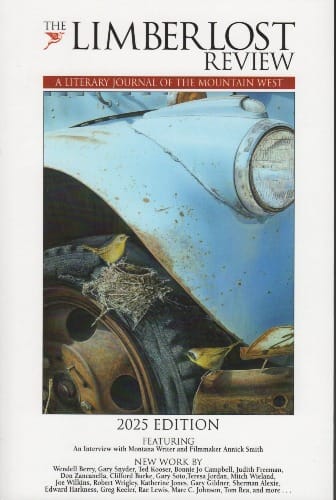
The idea to revive the review came years later, after he retired in 2018.
I had been thinking about it so much, and I woke up one night with the whole magazine mapped out…the sections, the people.
After a long career, he tapped his extensive network to launch the revived journal instantly. One important part to him is its existence as a hefty physical journal—not just a website.
I think there's a lot of interest in Limberlost being one of the last print journals. People like to take their books to bed. They like to read their work on paper still.
Starkness to Home
The discovery of the art of printing has defined much of Rick's creative work, but that serendipitous turn could not be separated from his move from the East Coast to Idaho in 1977.
It was a pretty stark country to visit for the first time. It really was quite stark coming into Pocatello off the interstate in Wyoming and down Route 30 and into Pocatello. Yeah, it was startling.
But Idaho pays off if you give it enough time. Pocatello is isolated but is "totally surrounded by beautiful country when you get to know it." Once again, Rick connected with a teacher, a great English professor and Wordsworth scholar named Ford Swetnam, who preferred advising students outdoors rather than meeting in offices.
Whenever I'd say, "Hey, I need to talk to you about something," he'd say, "Get your skis." We'd talk about it while we were hiking or climbing or skiing or something.
Rick quickly felt at home in the state. Professional opportunities soon came his way, and he developed deep firsthand knowledge of Idaho.
The opportunities were so great for us. I worked for the Idaho Centennial Commission as the public information officer for four years. One of the things that it really required me to do was visit every little town, every county in the state. That really helped in an incredible way in my work with the humanities when I joined the staff of the humanities council and became the director.
Empathy as the Core of the Humanities
Rick spent almost 30 years working for the Idaho Humanities Council (IHC), almost all of them as director. Such a position required him to frequently articulate the values of the humanities, particularly amid political challenges that undermined and devalued a humanistic life.
According to Rick, the central value of the humanities has become politically provocative in the conservative state:
I think one of the biggest revelations to me early on—and this is completely contrary to how the very conservative leadership in this state thinks—is that empathy was one of the things that we learned so well. Literature taught you empathy.
He can share numerous stories about how the IHC developed statewide programs that demonstrated this. For example, the "Let's Talk About It" program sent scholars to libraries in small towns to lead book discussions around diverse themes like "Women in the West."
The people who came to the 'Let's Talk About It' program were from very diverse backgrounds and political perspectives. They came together through literature. It teaches empathy to see the world through someone else's eyes. I think that's one of the greatest things from the humanities.
There was more than empathy, too.
The IHC also ran summer teacher institutes on topics ranging from Ernest Hemingway and John Steinbeck to the history of the Supreme Court and the Cold War.
These were all things that teach you responsibilities. The humanities taught us how to see the world through another person's eyes and to recognize our personal involvement, whether it's moral or political. That's what it always showed me.
Being able to advocate for the humanities is why Rick got the director job, despite having little experience raising money—a key attribute for a position like that. Rick recalls a board member saying, "No matter what we have to raise money for, we need somebody who's going to be able to write about it, speak about it, and articulate the value of the humanities and why we need to fund them."
Rick was effective at that. He started at another time—in the mid-1990s—when Congress struck an antagonistic stance against the humanities. Today's "demonization of education" is even worse, he thinks.
There's an attitude about liberal education in this country right now that is debilitating for the nation. I just think that there's a sad take that people have about college professors and people who read poetry and fiction and essays—people who read. There's a demonization of them, and it's a shame.
Although the times can appear bleak, Rick believes in the rising generation.
I think if we're going to be saved, it's going to be the young people who are finally going to say, "Look, we've got to change things."
You can count on the fact that those people will be readers.
The Landscape as Character: Creativity in the West
Rick's work with Limberlost Press and the IHC gave him a deep perspective on regional creativity. The landscape itself has inspired literary people of the West. The idea of place was omnipresent in conversations during his career.
I always said that I imagined the writers of Idaho almost being like Forest Service lookouts. They're up on their mountains, and they're reporting what they are seeing. I've always loved that. That's the way I saw writers in the West.
Even though the region is changing rapidly—"small towns are becoming big towns" and the "urban West is growing and growing"—Rick still sees the landscape as central to creativity if the artist chooses to see it that way, pointing to Gary Snyder (who he has published) as an example.
I love the work of Gary Snyder and the way he looks at the world—how we need to understand what a watershed is and learn about the place we live, rather than move around all over the place. Stay put. Find out where you live and why.
It circles back to the humanities, which helps promote an interdependent, holistic view.
Anyone who is really into the humanities, where they live is important to them. What they read is going to give meaning to their life. Understanding the history is only going to enrich their understanding of where they are. I really hate to see the demeaning of the humanities and the thought that they're less important than job skills. Nobody trained me to be a humanities director of a nonprofit. The reason you do what you do is because of what you know and what you love. I think it's all interconnected, and the love of the humanities is at the core. I hope we can revive that love.
I could not agree more.

You can keep track of Limberlost Press at its website and on Instagram and Facebook. You can order The Limberlost Review wherever you order books. If this profile intrigued you, find another interview with Rick at Atticus Review.
Comments ()