Commencement, 1969
Stephanie Mills and the idealism of graduations
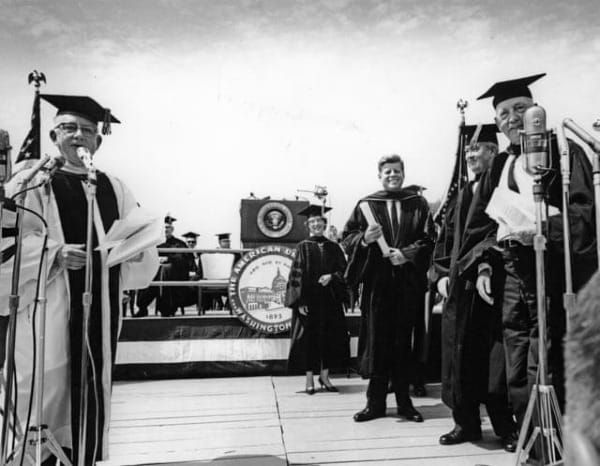
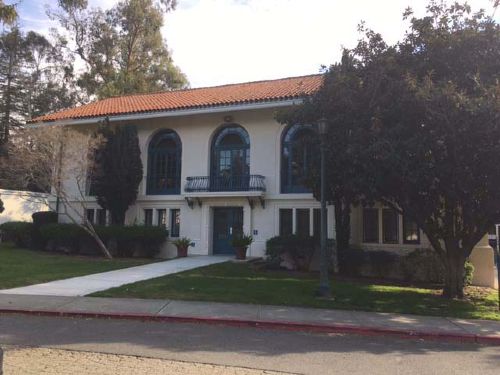
On the first day of June 1969, the graduating class of Mills College assembled before faculty and family to celebrate their accomplishments. A student speaker and valedictorian, Stephanie Mills, addressed the audience. Mills knew that such speeches typically looked to the future and painted it as “long and happy.” That would not do for her.
“It is a hoax,” Mills announced, referring to the future. “Our days as a race on this planet are, at this moment, numbered, and the reasons for our finite, unrosy future is that we are breeding ourselves out of existence.”
One imagines the audience at this small women’s college in Oakland started paying closer attention, some parents and faculty likely shifting uncomfortably in their seats.
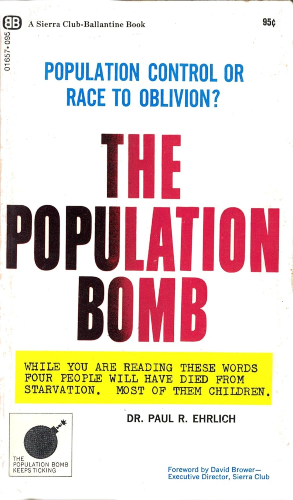
Like many other young people, Mills had fallen under the influence of the surprisingly popular book, The Population Bomb, published the previous year by biologist Paul Ehrlich.
The Population Bomb presented a dreary future of a crowded, hungry planet. The book marked a cultural moment—and sparked controversy then and since with the author’s larger-than-life personality, his alarmist predictions, and his focus on the Global South that some critics today view as tinged with racism, especially since governments used the scenarios he described to implement coercive sterilization policies.
The population debate infused Mills’ perspective—she called her speech “The Future Is a Cruel Hoax”—and inspired her urgency.
“I am terribly saddened by the fact that the most humane thing for me to do is to have no children at all,” Mills said, before calling herself “an ex-potential parent.” The only world she could envision ahead was “sad.”
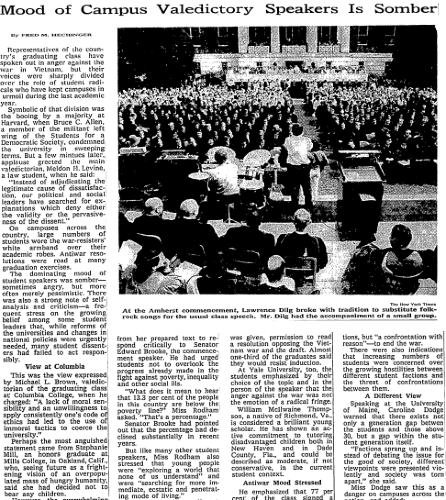
The New York Times covered the campus mood of 1969 graduations, calling it “somber.” The story included a brief mention of Mills, stating hers was “perhaps the most anguished” of the valedictory speakers that spring. (Of interest, three paragraphs below the mention of Mills was a section highlighting the remarks of one Hillary D. Rodham.)
Mills, who majored in contemporary thought, used the specter of a global population crisis and resulting famine as her speech’s hook, but she extended her comments to a deeper critique.
She criticized the “so-called real world, that is the non-academic world”—a distinction that anyone who has spent time in American academia has heard too many times to count.
A “peculiar brand of pragmatism” dominated that real world. According to Mills, that standard pragmatic logic didn’t develop electric automobiles because it wouldn’t be profitable. “This kind of pragmatism is false, nearsighted, and a very shallow form of self-delusion,” she said.
And then, Mills happened upon a central insight about the value of a college education that people overlook too frequently. “One of the advantages of a college education is escaping this kind of pragmatism for four years, being free of the small reality of earning a living,” Mills said. “From this freedom comes a long-range perspective, which is a desperate necessity—not a luxury.” By forgoing jobs and many living expenses, college students like Mills could “come to grips with the awesome reality of human survival on this planet”—something Mills felt as a “disheartening responsibility.”
Mills was describing the rare privilege to think and to do so without everyday practical burdens that college students can sometimes experience—harder now than then. By turning attention to long-range possibilities, they can change what the future can be.
“The real and unreal worlds both have to become pragmatic on a grand scale,” Mills warned, “or there won’t be any worlds left.” That meant eschewing so-called political realities that demanded caution. Instead, Mills urged action unconnected to profit or practicality as normally calculated. Assume the worst-case scenario will come to pass, she said.
If we believe that, we might finally act and accomplish something truly valuable.
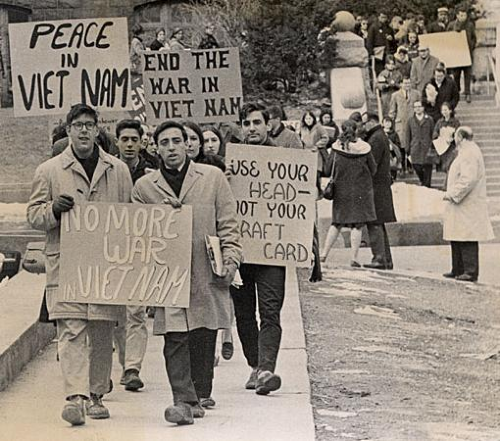
The journalist and environmental activist Bill McKibben included Mills’ address in the essential edited volume, American Earth: Environmental Writing since Thoreau (2008), which I taught for years and where I first encountered Mills. In his headnote to the text, McKibben said the speech reveals “what it felt like to be young and idealistic in the late 1960s.”
This is true. But it resonates strongly through the passing decades, too.
The population crisis and the climate crisis have sparked similar doom—and resolve—among young people. Mills’ choice to not become a parent was criticized at the time, much as young people today are criticized when they make similar calculations. And the upheaval on campuses so evident—and bemoaned—in 1969 no doubt echo in the 2020s as we stumble into graduation season.
Some families will squirm in their seats as students or guests make remarks the audience finds incendiary or uncomfortable or merely unfamiliar. But if they listen past that unsettledness, they will find beneath the frustration an idealism that people like Mills and her fellow graduates embodied.
“Doing something to save the human race has always been a fond dream of idealists both over and under thirty,” Mills concluded. That idealism is something to nurture, not belittle.
Comments ()