Dreams of a Channel
Transforming Swinomish Slough to “improve” nature
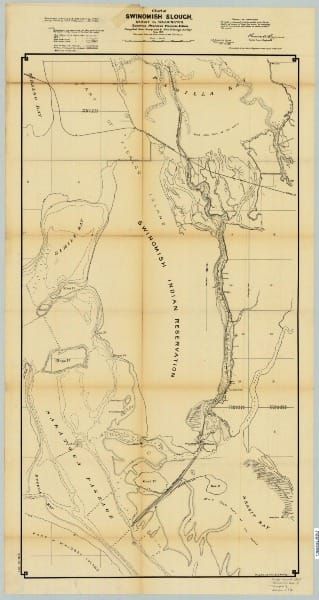
In April 1891, a survey crew rowed out in a small boat taking soundings of Swinomish Slough, a short watercourse that separated Fidalgo Island from the mainland in Skagit County. Following signals placed onshore and triangulations already prepared, the crew carefully took down measurements to find the mean of the lower low water, a measurement of the lowest tide of the day averaged over time.
These surveyors worked for the U.S. Army Corps of Engineers under an 1890 congressional authorization. Their task was to determine the feasibility of improving Swinomish Slough.
The Corps of Engineers quickly judged it a worthy project that would enhance transportation links for Skagit Valley. So, even in the 1890s, long before Tulip Festival crowds filled the byways, people were searching for better ways to move about the region.
There were fewer people then, the complications were significant, and they required big investments to fulfill these big dreams. But as a local paper, the Northwest Enterprise, put it in 1882, “Enterprising people in all countries prosper.” The publisher had dreamed of “profitable traffic” with steamers running on regular schedules through the inland waters, adding “incalculable value to the farmers of the mainland coast.”
Starting with those surveyors in 1891, federal dollars and engineers picked away at these ambitions rooted in improving nature.
Maritime commerce required safe routes for passage.
Three routes were available to move from northern Puget Sound to the cities further south. Ply the waters west of Whidbey Island. Go through Deception Pass and then take Saratoga Passage between Whidbey and Camano Islands. Or, take Swinomish Slough.
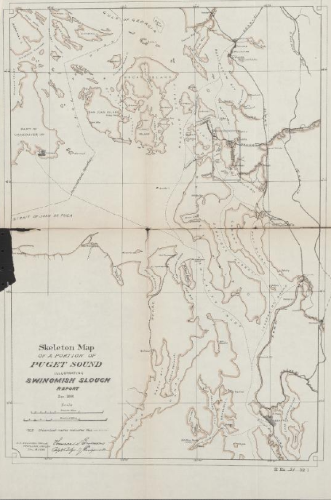
The first two options failed for small boats “owing to the heavy seas” west of Whidbey and the “dangerous passage through Deception Pass.” Swinomish was best, but it was “shallow and crooked.”
The slough served as “a valuable highway for the local steamboats plying on the sound, for rafts of logs and lumber, and small sailing craft going up the slough and its branches, carrying merchandise and taking out the products of the country,” according to the Corps’ 1891 report.
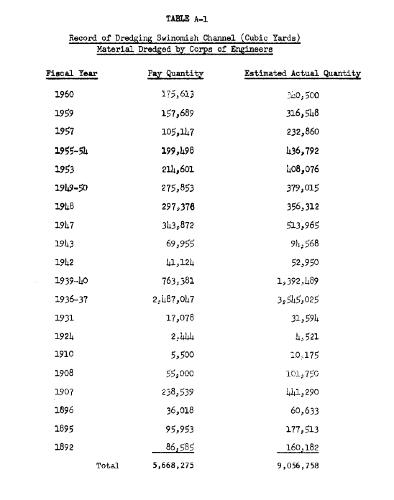
After its initial investigation, the Corps recommended a channel 100 feet wide and four feet deep at the mean of the lower low water, a scale that would require substantial dredging–some 413,000 cubic yards from Padilla Bay, Swinomish Slough, and Skagit Bay. (This would fill more than 30,000 dump trucks.)
Most of dredged material stayed close by, deposited on mudflats, in sloughs, and behind dikes. The dredging and diking costs were estimated at $122,000, or more than $4 million in 2026 currency.
Work began in 1893 with the first round finished by 1897, suggesting the scope and challenge of meeting expectations and fulfilling dreams.
This first effort facilitated more maritime traffic and prompted even greater ambitions
Statistics from 1912 showed nearly 65,000 tons of material and merchandise, valued at $1.4 million, coming through Swinomish Slough at La Conner.
By then, the Corps of Engineers called for more channel improvement. Already, more than $200,000 had been expended, including more than $30,000 just for maintenance. This had been directed not only toward dredging the channel but also building dikes, more than 15,000 linear feet to date.
All this work changed the nature of the slough, such as cutting off other sloughs, straightening the passage, and removing fish traps set by the Swinomish, which changed the patterns of shoals in the stream.
Although the Corps of Engineers acknowledged the fish traps, it did not concern itself with the economic, cultural, or ecological costs of their removal, much less the violation of treaty rights.
Despite the investments and progress toward realizing the dreams of a transformed Swinomish Slough, more changes were called for.
By 1932, the Corps of Engineers recommended deepening the channel to 12 feet at the mean lower low water.
Amid the Depression and many public works projects, this improvement was approved in 1935 as part of President Franklin Roosevelt’s New Deal. However, approval did not mean work began immediately.
Monrad Wallgren, who represented the region in Congress in the 1930s and later became governor, warned locals that the “seemingly endless fight” for the funding continued, complicated by typical congressional finagling.
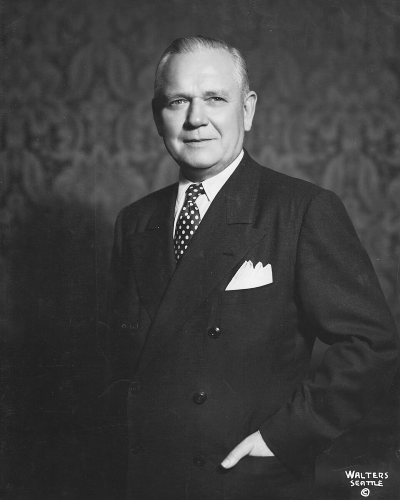
Despite Wallgren’s warning, dredging and dike construction began in August 1936 and finished in April the following year.
Because of flooding in 1937, more work was done on the southern end of the slough, including adding another 6,000 feet of dike, a task completed by the end of 1938.
Storms required repairs to dikes, and the dredged channel required regular maintenance. But by the time World War II started, the slough had become a channel and has been maintained that way ever since.
In the 1920s, even grander plans had been floated, including diking off Fidalgo Bay, which would have created 10,000 acres of farmland but closed Swinomish Slough. James W. Tarte of Bow, who believed he was the oldest living licensed sailor on Puget Sound and had first gone through the slough in 1872, wrote to the Skagit County Chamber of Commerce to object.
Tarte opposed this big dream to transform Skagit’s waterways, especially Swinomish Slough. “Nature or God Almighty provided that waterway,” Tarte wrote, forgetting to credit the Corps of Engineers for its substantial part. “It would be a crime to close it. It belongs not to us alone, but to generations to come.”
We are one of those generations. Whether we keep nurturing new dreams of “improving” nature will define how future generations praise or condemn the world we leave them.


Comments ()