Legacy of a Professor
Thoughts on the passing of a mentor
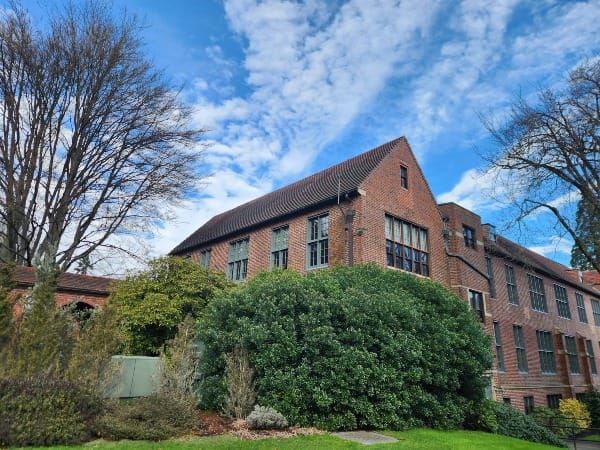
The classroom pulled in late morning sun. We always sat at tables arranged in a rectangle. At times, the light was uncomfortably bright, as was the subject and professor.
American Intellectual History to 1865—an intimidating course name that attracted me, an 18-year-old, because of my vague pretensions of becoming an “intellectual” someday. On the first day, the professor called my name, recognized it, and asked about my brother, who had graduated from the same college seven years before.
For the next four months, I swam against a deluge of difficult reading material and seemingly impossible expectations. But the experience invigorated me; by the end of the term, I declared a history major and asked the professor to be my advisor.
On Sunday, I drove two hours through rain and then sun to attend his memorial service.
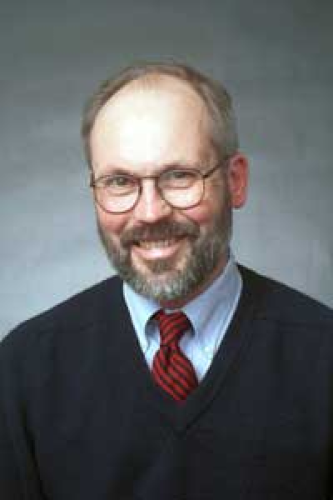
Bill Breitenbach taught history at the University of Puget Sound for almost forty years. He specialized in early American history. Besides the intellectual history course, I took him for the early US history survey, historical methods, and American transcendentalism.
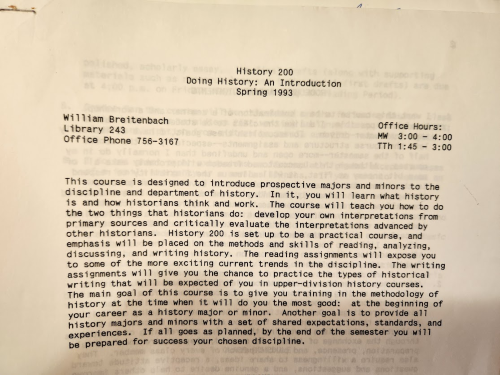
The history major then required ten classes; I took four from Bill. Although the topics that he taught were not ultimately where I focused my history career, he taught me how to think and write historically with more influence than anyone. My students benefited from many of those lessons, because I passed them along, even using some of his course materials because I never found anything better.
Bill was truly brilliant. I expect that he knew more about American history than anyone I’ve ever met. But he never performed it. Classrooms were not a place to showcase a professor’s intellect; they were places to cultivate a student’s growth. No sloppy thinking was allowed. Incomplete ideas were prodded. Hard questions were posed. He knew his answers; he didn’t need to prove that. Instead, Bill wanted ours and he wanted them to keep getting better. He combined an unending generosity with exacting standards. I was so lucky to have that as a model for what a college teacher could be.
Despite our differences, we were a good match, I think, because we cared about some of the same things. Namely, me becoming a better student—especially as a writer.
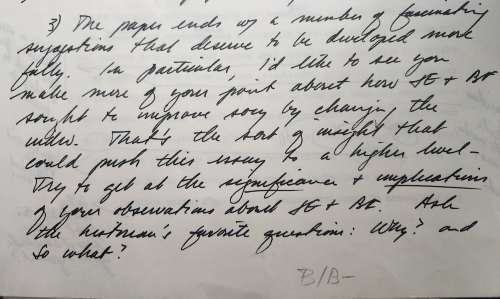
For our first paper in the intellectual history course—a comparative essay about the conversion stories of Jonathan Edwards and Benjamin Franklin—I was out of my depth. When Bill passed back the paper, I did something instinctive that I continued the rest of college. I started on page one and read and considered every comment. Only when I finished did I look at the grade.
For this paper, I read through comment after comment—starting with “Wordy” moving through lots of phrases crossed out and corrections (grammatical and historical) before ending with “Why end with this point?.” Then, Bill included a full page of handwritten suggestions for taking my ideas and making them better. He took my half-formed and poorly articulated ideas seriously and coached me how to develop them. Expecting the lowest grade I’d ever received, I was elated to finally see I earned a B/B-. After all those comments, that low grade felt like a gift.
Unknown to either of us, we had begun the Make Adam A Better Writer Project. It was a slow, bumpy ride. In fact, I’m still on it. As he told me once, “You’re on a journey with no end. You don’t wake up one day and finally are a ‘a good writer.’”
Although I am a shy person by nature, I was never shy about a professor’s office hours, so I often spent time in Bill’s office. Sometimes, I asked him about his copious comments so I could improve. In fact, there are three marks on that first paper that indicate I asked him to explain himself further—including the one time he wrote “Nice sentence” and I couldn’t figure out why!
But most of my office visits were for help on a paper. I arrived one day to find a new note on his door, meant for all students but seemingly designed just for me. I can’t recall the exact words, but I clearly remember the gist:
Dear Students: You are on the “right track” in your paper if it is the track that will take you where you want to go. You have to know where you want to go and what you need to get there. I cannot determine that for you. Now, how can I help?
I don't know how many times I had walked in, sat down, and said, “I just want to know if I’m on the right track.” With this note, he was telling me that only I could answer that question. Only the writer could know where they were going. Do the work, he implied. Trust yourself, he encouraged. But always, also, how can I help?
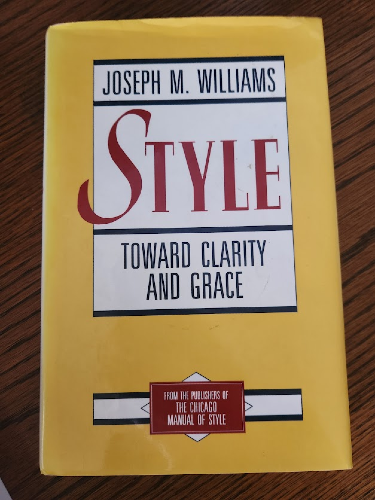
In another one of those office visits, Bill told me about a book on writing that could help me: Style: Toward Clarity and Grace by Joseph M. Williams. I immediately bought the book, in hardback, from the university bookstore. I’ve read it—and taught it—more times than I can count. It remains a touchstone that helped me unlearn a set of bad habits and gave me the language to understand why some things work better than others. Knowing it had Bill’s approval increased my estimation of its value.
Because he was my advisor, Bill talked with me about things other than the classes I had with him. Twice he warned me when I spoke to him about career plans. I heeded one and ignored the other.
He explained once that his wife was a law clerk for a judge, researching cases. (This is at least how I recall it from nearly 35 years ago.) Thinking that sounded like an interesting, practical, and potentially lucrative career, I started thinking about law school. When I mentioned this, Bill waved it off: “Yes, that research is fine and can be interesting. But in law school you have to take classes like Contracts. Ugh!” He may have just been voicing his opinion, or he may have recognized that my curiosity ran in different directions. But, thinking contracts did sound dull, I stopped considering law school almost immediately.
Eventually, I decided I wanted to go to graduate school to become a history professor. Bill did not discourage me and wrote letters of recommendation that made it happen. But he did warn me. “Being a professor isn’t sitting in an office,” he said, gesturing at all his books, “and reading and thinking. It’s mostly committee meetings.” The tone in his voice as he said “committee meetings” dripped with disdain. It couldn’t be that bad, I rationalized. But he was right.
He also knew that making a university work required serious people take their obligations seriously. I have no doubt he shouldered shared governance responsibilities with integrity. The Puget Sound community benefited.
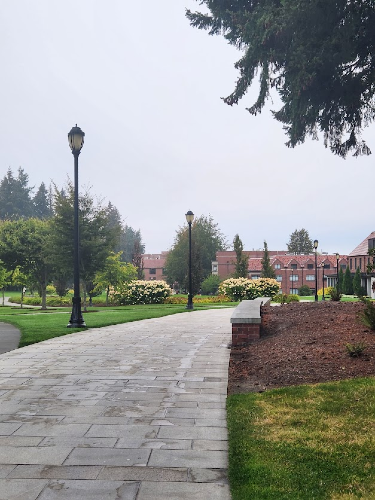
Once, I was standing in the hallway and talking with another history major. Bill walked by with a twinkle in his eye and a wry grin. “Fomenting rebellion?,” he asked. [EDIT: After consulting with my friend, I was reminded he actually said, "Fomenting sedition?"] We didn’t know what that meant, but we could tell the spirit in which Bill shared it. We would never incite a rebellion, but we learned a new word and got to be part of what seemed like an inside joke with this brilliant man who paused to make us laugh.
At the memorial service, Bill’s family shared a slide show and that smile beamed out at us, genuine and full.
I was struck by the stories shared by faculty who knew him far better than I had. They worked side by side for decades; I passed through in four years, three decades ago. But they described the man I knew. A man of unassuming brilliance, open-ended generosity, and great integrity. When that is your character, you are the same person to a student, a colleague, or a gas station attendant (who we heard from family members was perhaps one of his best friends).
Sixteen years ago, I visited campus and gave a lecture on one of my first books. It was nerve-wracking to stand before the people who prepared me to become a historian. I didn't want to disappoint anyone. Bill sent me a note afterward that read in part,
It was great to see you and to hear your excellent lecture. It was one of those occasions that will sustain me for weeks. It reminds me that what we do as teachers matters.
What he did as a teacher mattered enormously. I am grateful to have known Bill.
Comments ()