The Real Real World Around Us
Rachel Carson, beauty, and social critiques
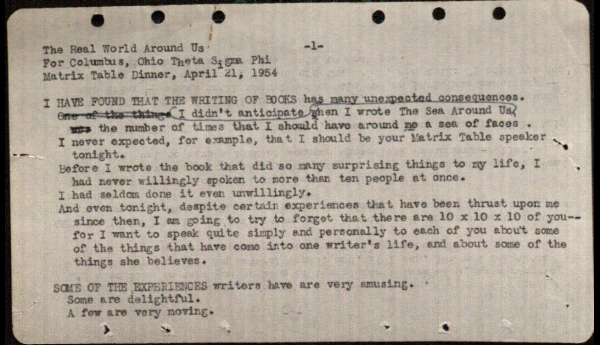
“No one can dwell long among such subjects [as the beauties and mysteries of life] without thinking rather deep thoughts, without asking himself searching and often unanswerable questions, and without achieving a certain philosophy.”
No one exemplified this more than Rachel Carson, who spoke those words in 1954 in a speech she called “The Real World Around Us.” Engaging closely with the natural world nurtures the deepest thinking and, I believe, develops an essential moral philosophy.
At the time, Carson was enjoying continuing praise for her most recent book, The Sea Around Us (1951), which had earned her a National Book Award. That book and her previous one, Under the Sea-Wind (1941), were masterful examples of natural history writing, combining keen scientific insights with lovely and powerful prose. She had begun working on her next sea-themed book, which would become The Edge of the Sea (1955). In early April, she gave a lecture on the research at Cranbrook Institute of Science. But Carson’s interests were broadening.
Two weeks later, when she delivered “The Real World Around Us,” Carson avoided almost all mention of her new work and focused instead on her values concerning the natural world and included far more autobiographical details than was typical. The speech suggests that the “real world” she referenced in the title was not only the natural world—her explicit topic—but also her life and the society in which she was embedded—her implicit focus.
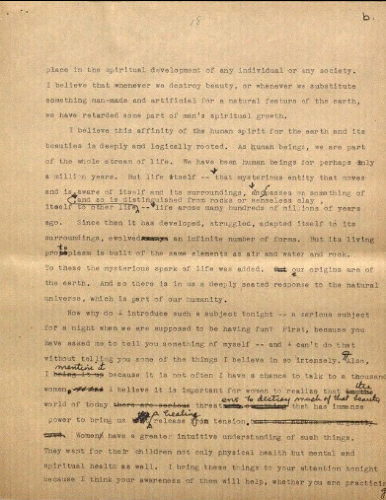
“I am not afraid of being thought a sentimentalist when I stand here tonight and tell you that I believe natural beauty has a necessary place in the spiritual development of any individual or any society,” Carson said. “I believe that whenever we destroy beauty, or whenever we substitute something man-made and artificial for a natural feature of the earth, we have retarded some part of man’s spiritual growth.”
Admitting to sentimentality had long been discouraged for scientists and had long been leveled at women scientists in particular. Carson stating this up front signaled her willingness to confront the stereotype. Her years of observing the “real world” showed her that detached objectivity—science’s gold standard—failed to capture nature fully.
Curiously, Carson was not the only one of her contemporaries thinking hard about beauty, artificiality, and spiritual growth. Just five years before, the forester Aldo Leopold published his land ethic in A Sand County Almanac. “A thing is right,” Leopold wrote, “when it tends to preserve the integrity, stability, and beauty of the biotic community. It is wrong when it tends otherwise.”
These two scientifically trained writers used “beauty” to describe the natural world as a whole and identified it as something beyond a simple pleasing aesthetic. “Beauty” here is not just a pretty view or a cute animal or a majestic forest. It is a fount of rightness, the basis of morality, judgment, and action. They rooted these bigger, philosophical foundations in a holistic natural world.
This reminds me of a comment from Brock Evans, a longtime Northwest activist, that I included in An Open Pit Visible from the Moon. “Odd as it may sound today,” Evans wrote retrospectively about his efforts to protect wilderness in the North Cascades in the 1960s, “we emphasized how beautiful the forests . . . were.” Biodiversity, ecosystem, connectivity—all critical scientific concepts—did not capture what required protection as well as “beauty” did. Carson, Leopold, and Evans all relied on beauty to capture something inherent in unexploited nature.
Then Carson extended her commentary in perhaps an unexpected direction: “We see the destruction of beauty and the suppression of human individuality in hundreds of suburban real estate developments where the first act is to cut down all the trees and the next is to build an infinitude of little houses, each like its neighbor.” In moving in this direction, Carson extended her social critique, rejecting the cramped conformity demanded by much of the culture of the 1950s.
Carson’s speech ended with her commentary about nature; it began with stories of being a woman, specifically a woman writer. These anecdotes warmed up the audience, but it also made social criticism central to “The Real World Around Us.”
Focusing on the challenges of writing as a woman was unsurprising given the audience, a society of women journalists, Theta Sigma Phi. They had invited Carson to address them at their Matrix Table Dinner in Columbus, Ohio.
Carson’s stories reveal a stark sexism. Carson reported that men doubted she could understand the science. One wrote to her, saying, “I assume from the author’s knowledge that he must be a man.” Another addressed his note to “Miss Rachel Carson” but led with “Dear Sir,” explaining “that he had always been convinced that the males possess the supreme intellectual powers of the world, and he could not bring himself to reverse his conviction.” Still another assumed she must be very old, for it would have taken a long time to learn so much. Even some people who worked for her publisher imagined her to be “a very large and forbidding woman” and were surprised to learn otherwise.
When Carson later published Silent Spring (1962) and took on the pesticide industry, she was subjected to a barrage of attacks rooted in her being a woman. Most notoriously, former Secretary of Agriculture Ezra Taft Benson wrote to former president Dwight Eisenhower questioning, “Why a spinster with no children was so concerned about genetics?” Benson decided it was probably communism.
It is clear in her speech, eight years before Silent Spring, that critics and colleagues trotted out sexist tropes long before her critical take on pesticides. This was part of the real world, too.
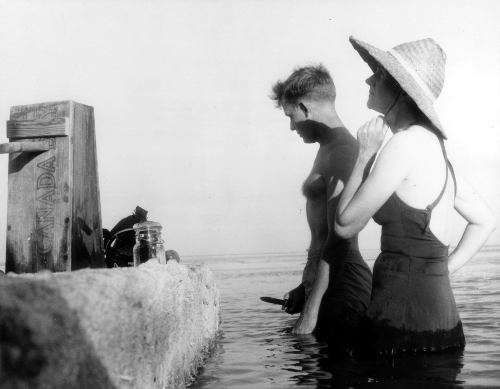
Carson ended her speech by reaffirming her natural values. Nature’s heart beats with a healing rhythm, she argued, and the “real world” deserved protection from destruction and artifice. “Mankind . . . is intoxicated with his own power, as he goes farther and farther into experiments for the destruction of himself and his world,” Carson wrote. “The more clearly we can focus our attention on the wonders and realities of the universe about us, the less taste we shall have for destruction.”
The destruction she targeted was the natural world—the sea, the forests, rivers. Unsaid but between the lines were sentiments about not destroying women, too. Not burying uniqueness under blandness. Not pursuing “selfish materialism” instead of beauty.


Comments ()