Waving the Wild Flag
E. B. White's hope for a peaceful world

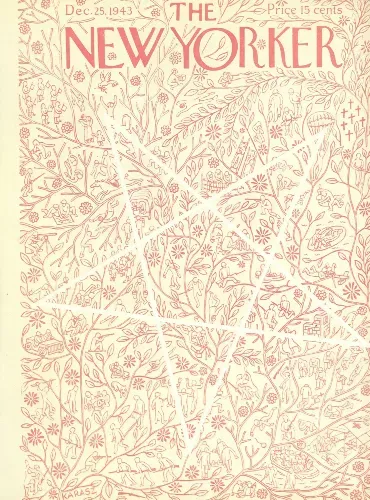
On Christmas, 1943, The New Yorker published an editorial described as a dream and structured as a parable. The writer imagined life after the third war had ended. There was only “a handful of people left alive, and the earth was in ruins and the ruins were horrible to behold.” The few survivors gathered to plan for peace.
Each country sent one delegate carrying their nation’s flag. But the Chinese delegate brought instead a living flower, a Roof Iris. This delicate symbol, the delegate proposed, could be a universal sign, something all nations could use. Then, no one would insult another’s “wild flag.”
Objections were raised. Delegates were skeptical a strong foreign policy could be pursued with such a wild flag. One demanded special flags for special races. Another thought the idea would be unpopular and therefore unworkable. The Chinese delegate countered that with only a couple hundred people left alive on the planet, perhaps it was time to act sensibly rather than by popularity.
Then, he gave each delegate a box with the iris, the wild flag.
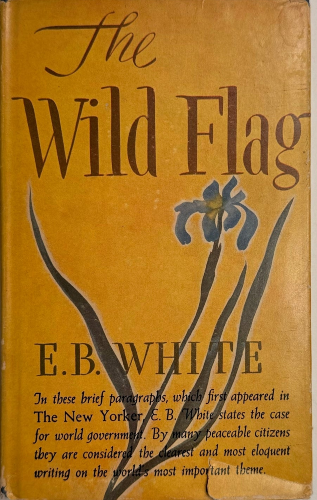
E. B. White wrote the parable and chose it for the title of his 1946 collection, The Wild Flag: Editorials from The New Yorker on Federal World Government and Other Matters. Recently, I saw this book referenced. I am a fan of White’s but somehow The Wild Flag had escaped my notice. I found a copy and read it quickly.
It’s a powerful experience to read a book like this—written amid World War II and its immediate aftermath from someone seeking to rally support for a new global governing system that would develop laws and promote peace . . . at the same time my own nation has chosen war again.
The hope and idealism evident in White’s words jars the sensibilities of an American in 2026. For my entire adult life, I have heard conspiratorial rumblings about the evils of “one world government” coming from the American right. To read arguments in favor of it sounds disorienting against the decades-long campaign to undermine the international order built after WWII.
One reason to study history, though, is to be a bulwark against short memories.
When White crafted these unsigned editorials from 1943 to 1946, much of the globe was engulfed in total war. And then, populations groped toward permanent peace. When the first editorials appeared, the Allies were making progress on the battlefield and planning for postwar victory. When the later editorials were published, President Franklin Roosevelt was dead, the atomic age had arrived, and the Nuremberg trials were underway. White—and his audience—wanted to know how to prevent destruction and achieve justice in the postwar world.
White remained uncompromising on justice. If no government were in place to create and enforce laws, then no “justice” could be delivered. He rejected policy and diplomacy as final arbiters, favoring law instead. The latter endured; the former bent with the winds.
And the challenge—then as now—rested in sovereignty. Nations understandably do not give up sovereignty lightly. But exclusively pursuing national interests produces conflict.
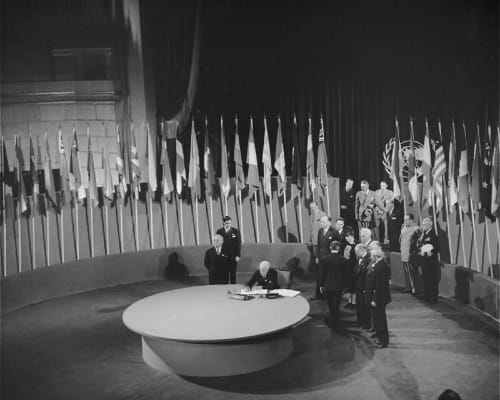
T. V. Soong, a Chinese diplomat, attended the conference in San Francisco in 1945 when the United Nations Charter was drafted. Soong announced that China was prepared to “yield if necessary a part of our sovereignty to the new international organization in the interest of collective security,” a statement that, according to White, brought acclaim from the audience. Other speakers had discussed unity and order to a meager response, but sovereignty hit the right note.
“To give this planet even one basic law would require that a little swatch be snipped from everyone’s flag and applied to the world’s banner, and that, of course, is the most delicate and dangerous surgery ever proposed,” White wrote. This was precisely what the emerging United Nations was attempting: cultivating common cause to ensure the dreadful war would not be repeated.
In July 1945, White hoped the Senate would ratify the UN Charter, but he expressed frustration that the UN did not amount to world government. It was “the best this country can do now,” he thought, and urged improving it right away.
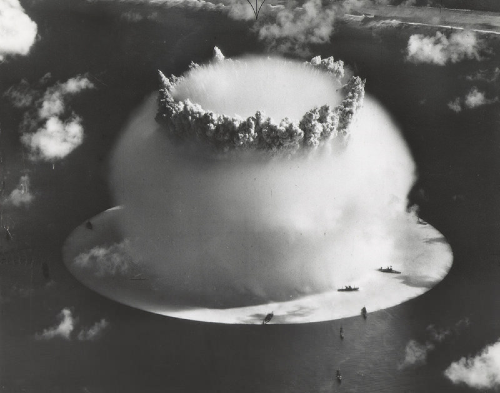
Reading through the book, from 1943 to 1946, White’s idealism bleeds occasionally into cynicism and frustration. “Nationalism has stiffened,” he observed at the end of 1945, just when it needed to soften. The atomic bomb, so freshly and devastatingly deployed, shook White and so many others to their souls. Something powerful needed to be invented to ensure peace universally.
But too many came to the United Nations —“a carnival of hope,” White called it—still focused on the nation. Addressing them, White implored: “If you would speak up for us, do not speak up for America, speak up for the people, for the free man. We are not dispatching you to build national greatness.”
That notion—the emphasis on all free people, not just fellow national citizens—appears again and again through The Wild Flag. The obstacle to peace rested in the unwillingness to see this. This appalled White. The evidence of war, the specter of atomic war—surely these required bold global action, not narrow interests. “Nationalism and the split atom cannot coexist on the planet,” he wrote in the final editorial contained in The Wild Flag.
Early in the book, in an editorial published exactly two years before the Americans dropped atomic bombs on Japan, White contrasted fascism with nationalism, a frustratingly relevant comparison:
Fascism is openly against people-in-general, in favor of people-in-particular. Nationalism, although in theory not dedicated to such an idea, actually works against people-in-general because of its preoccupation with people-in-particular. It reminds one of Fascism, also, in its determination to stabilize its own position by whatever haphazard means present themselves—by treaties, policies, balances, agreements, pacts, and the jockeying for position which is summed up in the term "diplomacy." This doesn’t make an America Firster a Fascist. It simply makes him, in our opinion, a man who hasn’t grown into his pants yet. The persons who have written most persuasively against nationalism are the young soldiers who have got far enough from our shores to see the amazing implications of a planet. Once you see it, you never forget it.
We have inherited these preoccupations. And it remains true that those who see the dire consequences of nationalism or fascism cannot unsee it. But when decades pass in relative freedom and peace, real conflict, real war, real destructiveness fade from memory, so we wave and wear our flags—the more ostentatious, the better.
We’d be better off waving our wild flags instead.


Comments ()