Pursuing Happiness and the Public Good
Frederick Law Olmsted's political vision for Yosemite
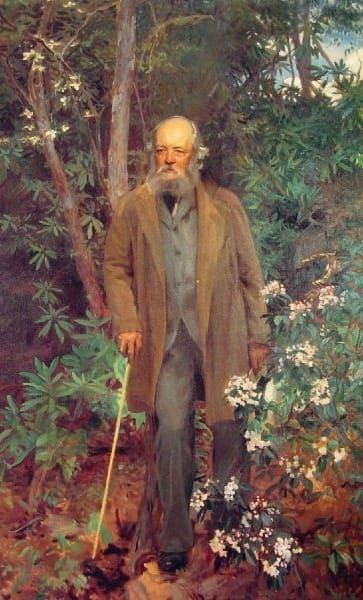
When he left for California in 1864, Frederick Law Olmsted was already famous for his designs of New York’s Central Park and as an executive secretary for the U.S. Sanitary Commission. Seeking better pay, Olmsted took over managing the Mariposa Estate, a vast land holding that included numerous mines. Writing to his wife upon arrival, he said he was “already experiencing the health-giving quality of the air,” a natural quality that helped “compensate for this terrible dryness. It is desolate country.” As a landscape architect and reformer, he was attuned to how the natural world could influence people.
Olmsted had arrived in California at an opportune time, just two months after the state learned that Congress had passed a law granting to the state two small but spectacular patches of land, Yosemite Valley and the Mariposa Big Tree Grove, for “public use, resort, and recreation.” It was the first such preservation in the nation’s history, and the legislation called for a commission to manage the park. Olmsted became the commission’s director.
Olmsted soon visited Yosemite and then spent most of a year writing his influential Preliminary Report upon the Yosemite and Big Tree Grove. This document expressed Olmsted’s ideas for what a nature park like Yosemite should be, something that has had a lasting impact on Americans’ thinking about national parks. Its context is also significant, because it reveals the profoundly political vision Olmsted brought to parks.
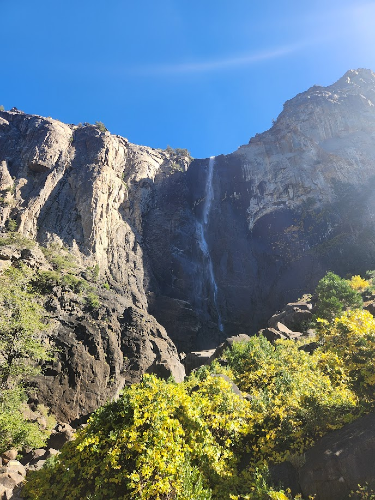
Olmsted believed people needed the positive influence of nature. “The power of scenery to affect men is, in a large way, proportionate to the degree of their civilization and to the degree in which their taste has been cultivated,” Olmsted thought. It was important to exercise these faculties and expose people to such places. Parks like Central Park or Yosemite in this view became sites of rejuvenation for Americans at a time of early industrialization and a growing middle class.
It is a scientific fact that the occasional contemplation of natural scenes of an impressive character, particularly if this contemplation occurs in connection with relief from ordinary cares, change of air and change of habits, is favorable to the health and vigor of men and especially to the health and vigor of their intellect beyond any other conditions which can be offered them, that it not only gives pleasure for the time being but increases the subsequent capacity for happiness and the means of securing happiness.
Direct contact with scenic wonders aroused individuals’ attention and helped occupy their minds with no purpose but the immediate experience. The enjoyment of the present moment in nature “employs the mind without fatigue and yet exercises it, tranquilizes it and yet enlivens it; and thus, through the influence of the mind over the body, gives the effect of refreshing rest and reinvigoration to the whole system.”
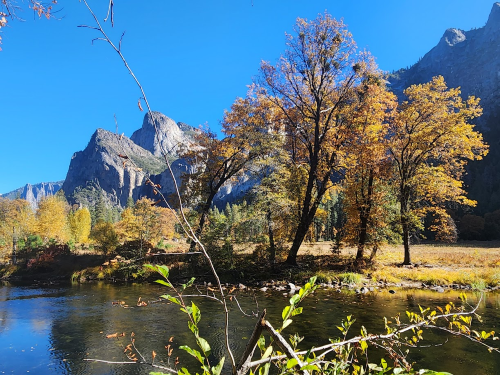
If those were general qualities nature furnished, Yosemite possessed special characteristics.
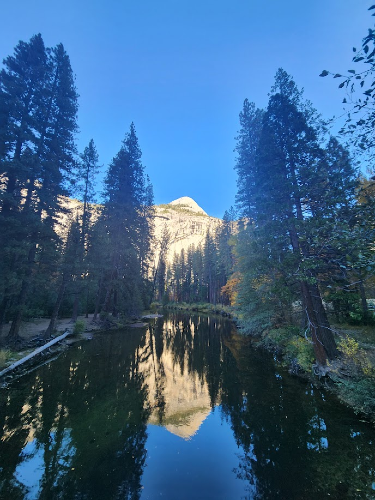
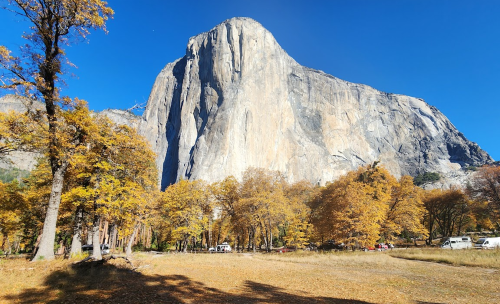
Olmsted thought the valley included many wonderous features, but there were better waterfalls and more spectacular rock walls and lovelier streams and meadows elsewhere. But not in one place.
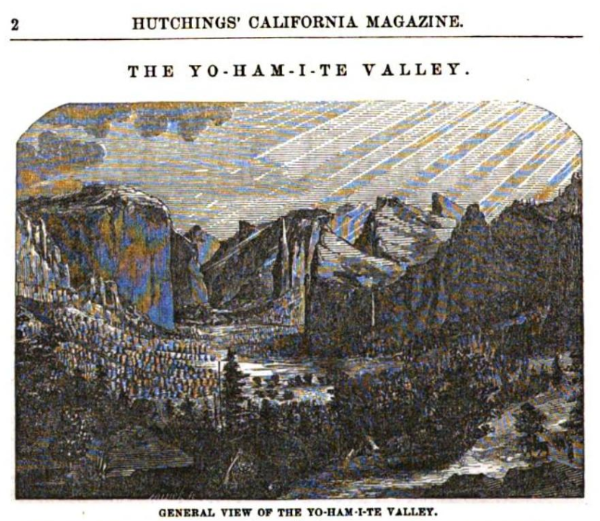
This union of the deepest sublimity with the deepest beauty of nature, not in one feature or another, not in one part or one scene or another, not any landscape that can be framed by itself, but all around and wherever the visitor goes, constitutes the Yo Semite the greatest glory of nature.
Olmsted stressed that nothing could prepare the visitor for such a scene. “No photograph or series of photographs, no paintings ever prepare a visitor so that he is not taken by surprise,” Olmsted wrote. I concur. In all my national park travels, Yosemite and Grand Canyon stand out. Other parks are certainly stunning, but these parks have a special you-have-to-be-there quality. “No description, no measurements, no comparisons are of much value,” Olmsted wrote.
To ensure Yosemite would remain spectacular, Olmsted focused his management plan on preserving it. “The first point to be kept in mind then is the preservation and maintenance as exactly as is possible of the natural scenery;” Olmsted wrote. “the restriction, that is to say, within the narrowest limits consistent with the necessary accommodation of visitors, of all artificial constructions an the prevention of all constructions markedly inharmonious with the scenery or which would unnecessarily obscure, distort or detract from the dignity of the scenery.” To preserve scenery and to prevent artificiality would keep the dignity of Yosemite intact.
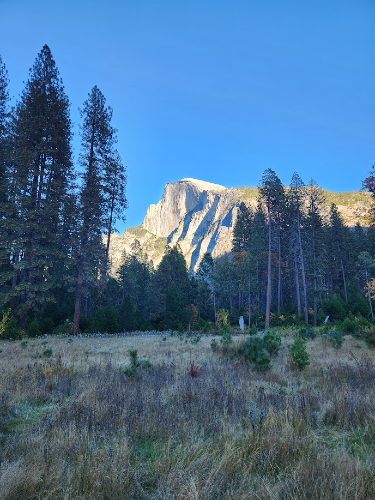
These two main ideas—that scenic nature is good for people and that Yosemite’s spectacular scenery should be preserved—are not that surprising for anyone who has visited or read much about national parks. That these notions feel almost intuitive, though, does say something about the power of Olmsted’s ideas, beliefs shared and expressed by his contemporaries like John Muir.
However, Olmsted’s Yosemite Report is something more. It is political. From the opening line, it revealed its context, referencing “the loyal people of the United States” and “the war of the great rebellion.” The report appeared in August 1865, three months after the traitorous Confederacy surrendered.
Olmsted saw in Yosemite another fulfillment of republican—and Republican—government. From the nation’s start, republicanism required virtue. Following John Locke, early American republicans saw private land ownership and controlling one’s own labor as repositories of such values. Olmsted agreed, after having found degraded land and labor systems in the slave-holding South. However, Yosemite helped him see that private property might corrupt the public good, too.
During the darkest days of the war, paintings by Albert Bierstadt and photographs of Carleton Watkins revealed Yosemite’s sublime beauty. Congress worried that “such scenes might become private property” and suffer from “the caprice of the requirements of some industrial speculation of their holders,” foreclosing enjoyment by future generations. So Congress “segregated from the general domain of the public lands, and devoted forever to popular resort and recreation” for these tracts of land. Congress didn’t want these places left in “the grasp of individuals.”
Olmsted described how the parks in Europe, especially Great Britain, remained private:
The enjoyment of the choicest natural scenes in the country and the means of recreation connected with them is thus a monopoly, in a very peculiar manner, of a very few, very rich people. The great mass of society, including those to whom it would be of the greatest benefit, is excluded from it.
Republican government demanded that such places be accessible to everyone.
Government, now having defeated the wretched Confederacy, could do more—and it must do more to fulfill its duty. “It is the main duty of government, if it is not the sole duty of government,” Olmsted wrote, “to provide means of protection for all citizens in the pursuit of happiness against the obstacles, otherwise insurmountable, which the selfishness of individuals or combinations of individuals is liable to interpose to that pursuit.” This view of government bore the mark of a victorious Union and a liberal republicanism then ascendant.
Olmsted reminds us that government holds higher duties: to promote equitable access to the pursuit of happiness and health beyond individual profit.
Many people recognize and appreciate Olmsted’s impact on Central Park. They know instinctively that he and his collaborators manipulated the land to make it pleasing and ensured that it seemed natural. In Yosemite, Olmsted recognized that less manipulation was needed and all that really needed to be done was to minimize human impact.
“Olmsted’s genius lay in peering into the heart of each landscape he came across and finding ways to bring out its best,” Dennis Drabelle wrote in The Power of Scenery (2021). Part of his genius also lay in peering into the heart of the American government and finding ways to bring out its best for its people.
Cross-Words
Past Taking Bearings essays that are complementary to this week's include:
 Adam M. Sowards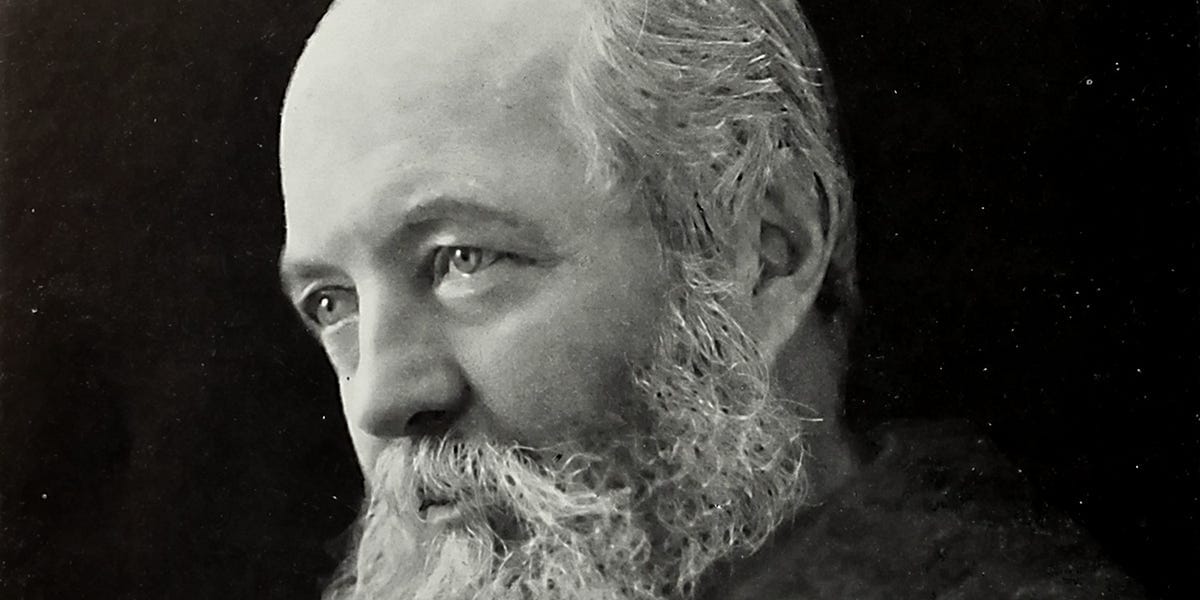
 Adam M. Sowards
This week, I relied on Olmsted: Writings on Landscape, Culture, and Society (2015); Rolf Diamant and Ethan Carr’s Olmsted and Yosemite: Civil War, Abolition, and the National Park Idea (2022); Dennis Drabelle’s The Power of Scenery: Frederick Law Olmsted and the Origin of National Parks (2021), and Adam Wesley Dean’s An Agrarian Republic: Farming, Antislavery Politics, and Nature Parks in the Civil War Era (2015).
Comments ()